
Rachel Ferreira, Beauty Editor.
You’re standing at the bathroom mirror on a Tuesday morning, can of dry shampoo in hand, wondering why your roots still look flat by lunchtime. The shelf under your sink probably holds two or three half-used bottles bought after a friend’s recommendation, each one abandoned when it didn’t quite work. Here is the useful fact most people never learn: dry shampoo does not clean hair at all. It absorbs oil the way a paper towel blots grease off a pizza box, and how well that works has almost nothing to do with the price on the can and almost everything to do with timing, distance, and whether you actually brush it out. This guide walks through the technique that makes the bottle you already own perform the way it was designed to.
- Timing beats product, spraying dry shampoo onto hair that is already visibly oily is too late; the starch works best applied the night before or first thing in the morning, before oil fully coats the strand.
- Distance and dose matter more than formula, holding the can too close or too far, and oversaturating the roots, is the most common reason for a chalky cast or no lift at all.
- Brushing out is not optional, massaging the product in with fingertips or a boar-bristle brush for 30 to 60 seconds is what distributes the absorbed oil evenly and prevents visible residue.
What Dry Shampoo Is Actually Doing To Your Hair
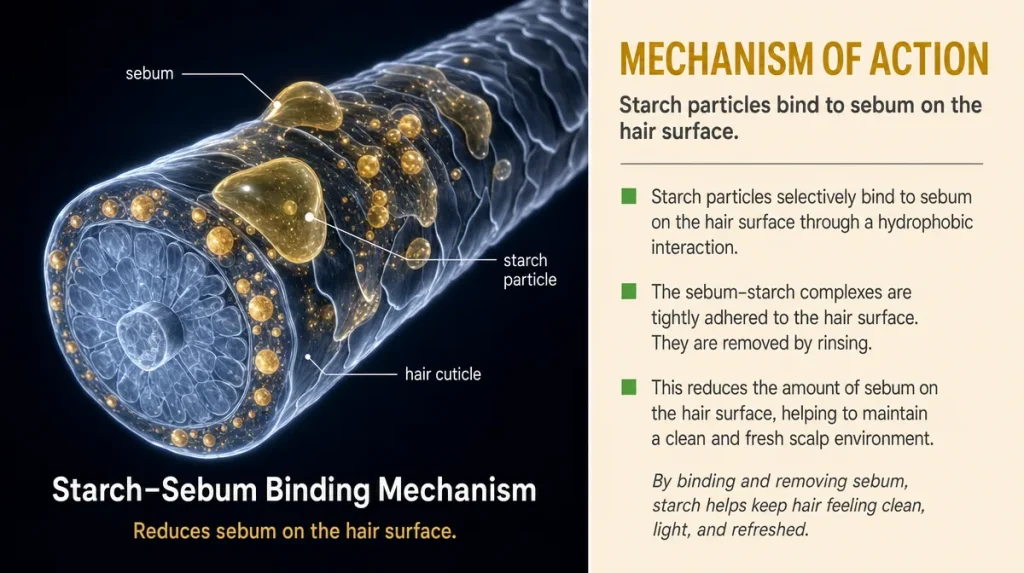
Dry shampoo is a delivery system for very small particles, usually rice starch, oat starch, or a clay like kaolin, suspended in an aerosol or applied as a loose powder. Those particles do one job: they soak up sebum, the oil your scalp produces continuously, the same way a paper towel pulls grease off a slice of pizza left on a napkin too long. The starch does not dissolve the oil or wash it away. It binds to it and sits on the hair shaft until you brush it out or shampoo it away with water. That distinction matters because it explains almost every complaint people have about the product: white cast, buildup, and the feeling that it stops working by afternoon are all a function of how much oil the particles were asked to absorb and how well they were distributed once they had done the job. A 2019 study published in the International Journal of Cosmetic Science measured sebum absorption rates across several powder bases and found starch particles capable of absorbing several times their weight in oil under laboratory conditions, though real-world results vary with hair texture and scalp oil output.
The Window That Determines Whether It Works
Most people reach for dry shampoo when their hair already looks greasy, which is exactly the wrong moment. Oil that has fully coated the strand and reached the ends is harder for the starch to absorb evenly, because it is spread thin over a large surface area rather than concentrated near the scalp where the particles can do their work. The better approach is to apply it the night before a day you know will be busy, or first thing in the morning on day-two hair, before oil has had time to travel down the shaft. Applying to slightly damp roots, right after the scalp has cooled from a shower the previous night, also helps the powder adhere rather than sit loosely on the surface. Waiting five to ten minutes after spraying before brushing out gives the starch time to finish absorbing, rather than smearing half-absorbed oil around with a brush too soon. This single change, timing the application before visible grease rather than after, is the adjustment hairstylists mention most often when clients say a product isn’t working for them.
Sectioning And Spray Distance

Technique fails most often at the can itself. Holding an aerosol six to eight inches from the scalp, the distance recommended on most labels, prevents the concentrated blast that causes visible white patches. Closer than that and the powder lands in one spot instead of dispersing; farther and most of it never reaches the roots at all. Part the hair into two-inch sections, working from the crown back, and spray directly at the roots rather than along the length of the hair, since oil accumulates at the scalp first. A light, even pass across each section beats one heavy pass down the middle. People with fine, thin hair tend to need less product than they think, since a small amount of oil absorption goes further when there is less strand to cover. Those with thick or coarse hair often need to lift sections with a comb or the fingers to spray underneath, at the scalp, rather than relying on the top layer to do the work for the layers beneath it.
Working It In Without The Flakes
Spraying and walking away is the step that produces the most complaints about residue. Once the powder has had a few minutes to absorb oil, it needs to be distributed, either with clean fingertips massaging in small circles at the roots, or with a brush pulled through in short strokes from scalp to mid-length. A natural-bristle brush works particularly well because the bristles pick up loose powder rather than pushing it deeper into the strand. Flipping the head upside down and brushing from the nape forward for a minute reaches sections that are easy to miss when working top-down. Skipping this step is the single most common reason for the chalky look people associate with dry shampoo in general, when the actual cause is incomplete distribution rather than the product itself. A quick self-test: run a finger along the part line after brushing out. If it comes away with visible white residue, the section needs another ten seconds of brushing, not less product next time.
Matching Formula To Your Root Type
Not every dry shampoo is built for the same amount of oil. Lighter, rice-starch or oat-starch formulas tend to suit fine hair or moderate oil production, since they absorb enough without weighing down thin strands. Clay-based formulas, often kaolin or bentonite, are heavier and better suited to thicker hair or scalps that produce oil quickly, because clay particles hold more oil relative to their volume. Using a heavy clay formula on fine hair often produces the dull, coated feeling people describe as buildup, while using a light starch formula on very oily roots may simply run out of absorbing capacity by early afternoon. There is no universal best formula, only a better match for a given scalp and hair type, and that match is worth testing over a week of ordinary days rather than judging from a single use.
Dark Hair And The White-cast Problem
The visible white or gray cast that shows up on dark or black hair is simply the starch itself, which is naturally pale, sitting on the surface before it has fully absorbed oil or been brushed through. Tinted dry shampoo formulas, now widely available in shades from light to deep, add a small amount of pigment to the powder so it blends rather than sits as a visible layer. Even with a tinted formula, the fix is largely technique: apply less than feels intuitive, focus the spray directly at the part and roots rather than broadly across the crown, and brush thoroughly before judging the result. A trick many stylists use is to spray into a makeup brush or onto the fingertips first, rather than directly onto the hair, which allows more control over placement, particularly along a visible part line where cast is most noticeable.
Seasonal Recalibration For Humid Summers And Dry Winters
Climate changes how much oil your scalp produces and how dry shampoo behaves once it is there. Humid East Coast summers tend to increase sebum production and can make powder clump slightly in the moisture, so a lighter dose applied more frequently often works better than a heavy single application. Dry winter months, with indoor heating pulling moisture out of the air and the scalp, often bring less oil but more flaking, which can be mistaken for dry shampoo residue when it is really dry skin. In that season, brushing more gently and possibly reducing frequency to give the scalp a break matters more than switching products. The Mayo Clinic’s general guidance on winter skin dryness notes that indoor heating lowers ambient humidity significantly, which affects scalp skin the same way it affects hands and lips, a detail worth remembering before blaming a product for a change that is really seasonal.
Reading Your Scalp Instead Of The Calendar
Plenty of routines are built around a fixed schedule, wash every other day, dry shampoo in between, without checking whether the scalp actually needs it that way. A more reliable method is watching for specific signals: visible shine or flatness at the crown means it’s time for powder, an itch or tightness that doesn’t resolve after brushing usually means it’s time for actual water and shampoo, since dry shampoo cannot clean the scalp or remove product buildup on its own. The American Academy of Dermatology’s public guidance on scalp health points out that a healthy scalp sheds skin cells and oil continuously, and that relying too long on absorbent powders without washing can trap that buildup rather than remove it. A simple test: after applying and brushing out dry shampoo, if the scalp still feels coated or slightly tacky rather than clean and light, that’s usually the signal a real wash is overdue, not a sign to reach for more powder.
Buildup, Pilling, And The Wash You Can’t Skip
Even with perfect technique, dry shampoo particles accumulate over repeated uses, especially near the scalp where they are applied most heavily. Left too long, this buildup can combine with natural oil and styling residue to create a slightly gritty or dull feel, sometimes described as pilling, which no amount of extra brushing will fully resolve. This is not a flaw in the product, it is simply what absorbent powders do when they are not periodically washed away. A clarifying shampoo, used every one to two weeks depending on how often dry shampoo is used, removes this layer and resets the scalp so the next application of powder has a clean surface to work with. Skipping this step is the most overlooked reason a dry shampoo that worked well for a month suddenly seems to stop working. The product hasn’t changed. The surface it’s being applied to has.
Key Takeaways
Dry shampoo absorbs oil rather than cleaning hair, so timing it before oil fully coats the strand matters more than which bottle is on the shelf. Spraying from six to eight inches away, in sections, directly at the roots, prevents both the chalky cast and the wasted product that comes from spraying the wrong distance. Brushing or massaging it in for a full minute is what turns absorbed oil into invisible, distributed results rather than visible residue. Matching a lighter starch formula or a heavier clay formula to your actual oil production, and adjusting frequency for humid summers versus dry winters, does more for results than switching brands. None of this replaces an occasional real wash, since powder buildup eventually needs water and shampoo to clear.
A Quick Before-you-spray Checklist
- Apply before hair looks visibly oily, ideally the night before or first thing in the morning.
- Hold the can six to eight inches from the scalp and work in two-inch sections.
- Spray at the roots, not along the length of the hair.
- Wait five to ten minutes before brushing to let the powder finish absorbing.
- Brush or massage thoroughly, flipping the head upside down to reach the nape.
- Check the part line with a finger; brush again if residue shows.
- Choose a lighter formula for fine hair and a heavier one for thick or very oily roots.
- Book in a clarifying wash every one to two weeks to prevent buildup.
This article is for general information only and does not replace advice from a licensed dermatologist or hair care professional.
Individual results vary based on hair type, scalp condition, and product formula.