
Rachel Ferreira, Beauty Editor.
You are standing in front of a shelf of half-used bottles, the ones that seemed perfect in the store and smelled like nothing by dinnertime, or worse, gave you a headache by noon. Somewhere in that shelf is a $68 mistake and a $14 lucky guess, and you are not sure which is which anymore. If you have ever typed “why does my perfume disappear” or “best eau de parfum for beginners” into a search bar at midnight, this guide is for you. One useful fact before anything else: concentration percentage, the number nobody explains at the counter, matters more than the brand name printed on the box. An Eau de Parfum typically holds 15 to 20 percent aromatic compounds, roughly double what you get in an Eau de Toilette. That single number explains most of what confuses new buyers: why one bottle vanishes by lunch and another lingers into the evening, and why one costs three times as much as its cousin in a nearly identical bottle.
- Concentration decides longevity more than brand or price: an Eau de Parfum’s 15 to 20 percent aromatic oil content is the real reason it lasts longer than an Eau de Toilette.
- Skin chemistry changes a fragrance more than the bottle does: body heat, dryness, and even hydration levels can shift how a scent reads within the first hour.
- Testing on paper tells you almost nothing useful: a scent needs at least four hours on skin before you can judge it fairly.
What “Eau De Parfum” Actually Means
Walk into any drugstore fragrance aisle and you will see four or five versions of nearly the same word: Eau de Cologne, Eau de Toilette, Eau de Parfum, Parfum. The difference is not marketing, it is math. Each term refers to the percentage of aromatic compounds dissolved in an alcohol and water base. Eau de Cologne sits around 2 to 4 percent, Eau de Toilette around 5 to 15 percent, Eau de Parfum around 15 to 20 percent, and Parfum, or extrait, can run as high as 30 percent. Think of it the way you think of orange juice concentrate. A weaker concentration behaves like juice diluted with extra water: it tastes fine in the moment but thins out fast. A true Eau de Parfum is closer to full-strength juice, richer from the first sip and slower to fade. That is why an Eau de Parfum applied at 9 a.m. can still be detectable at 4 p.m., while an Eau de Toilette from the same scent line often needs reapplication by lunch. The percentage is rarely printed clearly on the box, so the naming convention is your best clue. If longevity through a full workday matters to you, an Eau de Parfum is usually the safer starting point over an Eau de Toilette, even though the bottle costs more. Cheaper is not always the better beginner choice here: paying once for a concentration that lasts is often more economical than repurchasing a lighter version every few months.
The Three-layer Structure: Top, Heart, And Base Notes
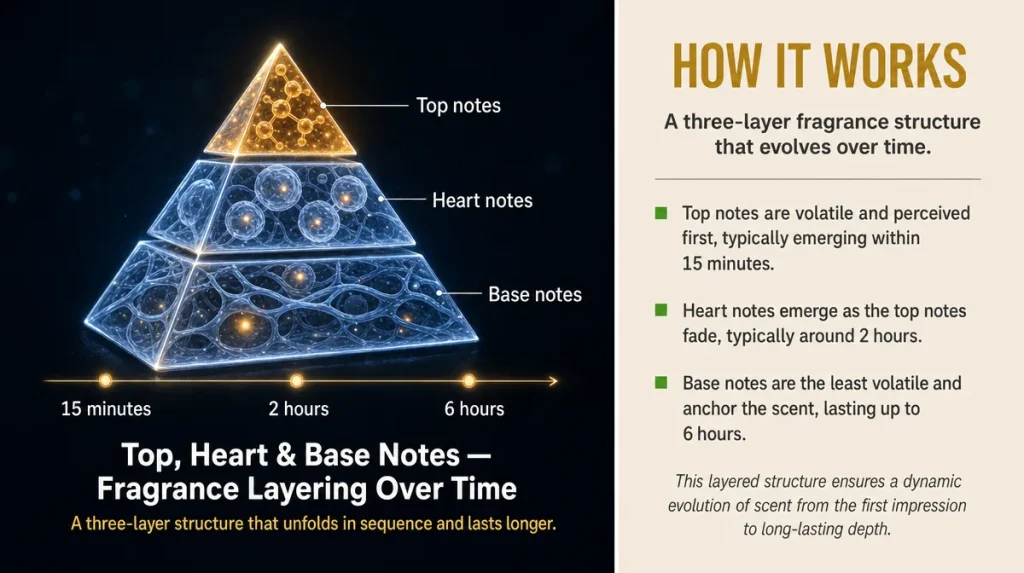
Every fragrance is built in three layers, and understanding them will change how you shop. Top notes are the citrus, herb, or light floral molecules you smell in the first fifteen minutes. They are small and volatile, meaning they evaporate fast, which is exactly why a fragrance smells different on a paper strip than it will on you an hour later. Heart notes, often rose, jasmine, spice, or fruit, emerge as the top notes fade and form the true character of the scent for the next two to four hours. Base notes, typically musk, wood, amber, or vanilla, are the heaviest molecules. They take the longest to surface, sometimes 30 minutes or more, but they are also what lingers on a scarf or sweater the next day. A useful analogy is a three-course meal. The top notes are the appetizer, memorable but brief. The heart notes are the entree, the part you actually planned the meal around. The base notes are dessert, the last thing you taste and the flavor you remember on your walk home. A common beginner mistake is judging a fragrance entirely by its top notes, deciding within the first minute at the counter, then wondering later why the bottle at home smells nothing like what was tried in the store. The base notes, responsible for how the scent actually reads for most of the day, have not even arrived yet.
How To Test A Fragrance Without Wasting A Sample
Spraying a fragrance on a paper card and sniffing immediately, the standard department store move, tells you almost nothing about how it will behave on you. Skin has its own pH, temperature, and oil content, and all three interact with the same molecules differently from one person to the next. A 2019 study in Flavour and Fragrance Journal found that individual skin chemistry, including natural lipid levels, measurably altered how quickly certain fragrance compounds evaporated between subjects. The practical fix is simple. Spray one fragrance on the inside of your wrist, then leave it alone for at least 30 minutes before forming an opinion, and check it again after four hours. Do not test more than two scents on your skin in a single outing. After the third, your nose genuinely cannot tell them apart, a phenomenon perfumers call olfactory fatigue. If you are testing at a counter, smell coffee beans or the inside of your own elbow between scents to reset. Try this the next time you shop: spray your top choice on one wrist and your second choice on the other, then go run an errand. Whichever one you catch yourself noticing, unprompted, an hour later, is usually the honest answer.
Why Rubbing Your Wrists Together Ruins The Scent
Almost everyone does this without thinking: spray both wrists, then rub them together like warming up before a meal. It feels natural, but it actively damages the fragrance. Friction generates heat, and heat accelerates evaporation, which means the fragile top notes burn off within minutes instead of unfolding the way the perfumer intended. It is a little like rubbing a matchstick against sandpaper before you actually need the flame: you use up the reaction early, and there is less left when you need it. General guidance from the American Academy of Dermatology on fragrance products has also noted that repeated rubbing on freshly sprayed skin can increase irritation in people prone to contact sensitivity, since it works the alcohol base more aggressively into the skin barrier. The better habit is to spray and let the fragrance settle on its own, or at most pat very lightly, if at all. It is a small change, but it is one of the few free adjustments that immediately improves how a fragrance performs, no new purchase required.
Finding A Scent Family That Matches Your Taste
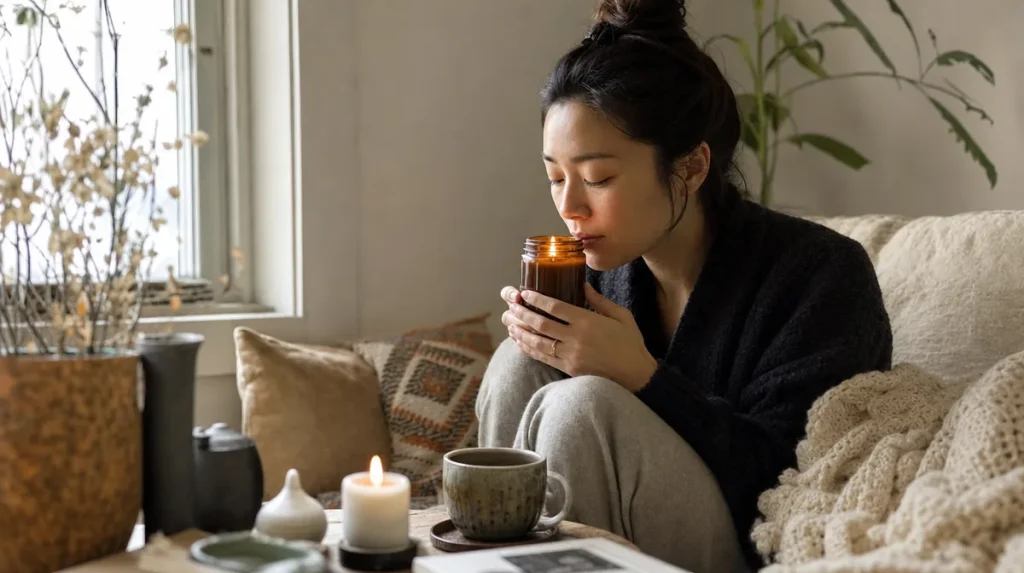
Fragrance families exist because most people already have a preference, they just have not named it yet. The four broad categories are floral, woody, fresh (citrus and aquatic), and oriental or amber (warm, spiced, often vanilla-forward). Before you smell a single bottle, take stock of what you already gravitate toward elsewhere. Do you light woody or amber candles at home, or do you prefer something described as clean linen or citrus. Do you order desserts with vanilla and warm spice, or do you reach for a lemon tart. Preferences in food, candles, and bath products are a genuinely useful predictor, because they draw on the same part of the brain interpreting the same categories of molecules. A short self-test: think of the last three candles, lotions, or air fresheners you actually repurchased instead of using up out of guilt. Write down one word for each. If two or more land in the same family, floral, woody, fresh, or amber, start your fragrance search there rather than wandering the entire aisle. Most beginners waste their early fragrance budget sampling across every family at once, when in fact their existing habits already point toward one or two.
Where Fragrance Actually Lasts Longest On Your Body
Fragrance clings longest to skin that already holds moisture. Dry skin has fewer natural oils to bind the fragrance molecules, so the scent evaporates faster, sometimes noticeably faster in the dry winter months when indoor heating strips humidity from the air and from your skin at the same time. This is why perfumers and beauty editors alike recommend applying an unscented lotion to pulse points, wrists, the base of the throat, behind the knees, before spraying. Think of it the way a primed wall holds paint better than bare drywall: the base coat gives the top layer something to grip. Pulse points work because they run warmer than the rest of the body, and gentle warmth helps a fragrance release its scent gradually over hours rather than all at once. Skip the classic advice to spray behind the ears if you have sensitive skin there, since that area sees more friction from hair, scarves, and phone calls than people expect. A more comfortable and equally effective spot is the inner elbow. During humid East Coast summers, fragrance may seem to project more heavily within the first hour and fade a little sooner overall, simply because humidity affects how molecules travel through the air.
Storage Mistakes That Quietly Ruin A Bottle
A bathroom shelf is the worst place to store a fragrance, even though it is where most people keep it. Heat, light, and humidity all break down the aromatic compounds over time, and a bathroom reliably delivers all three every time someone showers. Sunlight coming through a window does similar damage, which is why fragrance bottles are so often tinted or boxed. The safest spot in most homes is a bedroom drawer or closet shelf, somewhere dark, dry, and closer to room temperature. A fragrance stored properly can hold its character for two to three years after opening; one left on a sunny windowsill or a steamy shelf can turn noticeably sharper or duller within months. You will usually smell it before you can name what changed: a fragrance that once read as warm and rounded can start smelling flat or slightly vinegary once the top notes have degraded unevenly. If a bottle has been sitting in a hot car or near a radiator, even briefly, spray a test patch before assuming it still performs the way you remember. There is no fix once the breakdown has started, so prevention is the only real strategy.
What Marketing Claims To Ignore And What Actually Matters
The note list printed on a fragrance box is a marketing translation, not a literal ingredient list. “Notes of blackberry and cashmere wood” describes an impression the perfumer wants you to imagine, not necessarily actual blackberry or wood extract in the bottle. That is not dishonest, it is simply how the industry communicates, the way a candle labeled “ocean breeze” does not contain ocean water. What is worth checking instead: the concentration terminology discussed earlier, whether the brand discloses full ingredient lists, and independent reviews rather than the brand’s own longevity claims. A 2020 study in the Journal of Sensory Studies found that consumers’ perceived longevity of a fragrance often diverged significantly from measured molecular presence on skin, meaning people frequently believed a scent had faded when trace amounts were still detectable by instrument, and vice versa. In practice, this means marketing claims like “lasts 24 hours” should be treated as an aspiration, not a guarantee, since your own skin chemistry and the climate that day will do more to determine actual performance than any claim on the box. Celebrity names and elaborate bottle design tell you nothing about how a fragrance will behave on your particular skin.
Key Takeaways
A higher concentration, not a bigger name, is what makes an Eau de Parfum last. Judge a fragrance on skin, not paper, and give it at least four hours before deciding. Skip the rubbing, moisturize pulse points first, and store bottles away from heat, light, and bathroom humidity. Your existing candle and dessert preferences are a better starting map than any note list on a box.
A Quick Checklist Before You Buy
- Confirm it is labeled Eau de Parfum, not Eau de Toilette or Cologne, if longevity matters to you.
- Apply to skin, wait 30 minutes, then check again after four hours before deciding.
- Test no more than two scents per outing to avoid olfactory fatigue.
- Moisturize pulse points first, and spray rather than rub.
- Store the bottle in a dark, dry drawer, never on a bathroom shelf or windowsill.
- Treat note lists and “all-day” longevity claims as marketing language, not guarantees.
This guide is for general information only and does not replace advice from a dermatologist or allergist.
Individual results and skin reactions may vary.