
Danny Osei, Staff Writer.
You are standing in front of the bathroom mirror at eleven at night, and your skin still feels like it has a film on it even after you rinsed with the cleanser you have used for a year. Somewhere in a drawer there are two half-charged brushes you bought after seeing them everywhere, and you are typing the same question into your phone that a lot of people type: do these things actually work, or is it just the cleanser doing the work and the brush doing the marketing? The honest answer sits in between, and it depends on details most product pages never mention: bristle stiffness, motor motion, and how your particular skin handles friction. A useful fact to start with: dermatology researchers who study cleansing methods generally find that the mechanical action of a brush can lift more debris and oil from the skin’s surface than fingertips alone, but the same motion that helps a thicker, oilier complexion can irritate a thinner or reactive one within weeks. This guide walks through what is worth paying attention to, what is packaging noise, and how to test any brush you already own or are considering, so you can judge for yourself instead of trusting a label.
- Bristle stiffness matters more than speed settings: a soft, dense brush head does most of the useful work; higher oscillation speed mainly increases the risk of irritation.
- Two minutes of gentle contact beats thirty seconds of hard scrubbing: results come from consistent light pressure over time, not from pressing harder.
- Skin that flushes, stings, or feels tight after use is telling you something real: those signs mean the barrier is being disrupted faster than it can recover, regardless of what the brush promises.
Why A Spinning Brush Can Help Or Hurt The Same Skin

A facial cleansing brush is, at its core, a small motor attached to bristles, and the job it does is mechanical rather than chemical. Think of it the way you’d think of a soft-bristle dish brush versus a stiff scrub pad: both remove residue, but one is built for a delicate glass and the other for a cast-iron pan. Your face is closer to the glass.
The outermost layer of skin, the stratum corneum, is a thin barrier of overlapping cells that holds moisture in and keeps irritants out. Gentle mechanical action can loosen dead cells, sunscreen residue, and oil sitting on top of that layer, which is why many people notice smoother texture after a few weeks of consistent use. But if the bristles are too stiff, the motor too fast, or the pressure too heavy, that same action can thin the barrier faster than skin cells can replace it.
A 2019 study in the Journal of Cosmetic Dermatology comparing manual and device-assisted cleansing found that sonic-style brushes removed measurably more makeup and sunscreen residue than washcloths in a single session, but the same research noted increased redness in participants with reactive skin when brushes were used daily rather than a few times a week. That gap between what a brush can remove and what skin can tolerate is the whole story. It is not a question of whether brushes work. It is a question of matching bristle type and frequency to what your own skin can handle without protest.
Reading Bristles Like A Label You Can Trust
Packaging rarely tells you bristle stiffness in plain terms, so you have to test it with your fingertip. Press the bristle head against the inside of your wrist. If it feels closer to a soft toothbrush, that is generally appropriate for daily facial use. If it feels closer to a nail brush, that head is built for exfoliation on rougher areas, not for cheeks or under-eye skin.
Silicone bristles behave differently from nylon ones. Silicone tends to be softer and easier to keep clean, since it does not hold bacteria the way porous nylon bristles can between washes. Nylon bristles can offer more mechanical lift for oilier or thicker skin but need replacing more often, roughly every three months, because they fray and stiffen with use.
A simple self-test: run the brush dry against the back of your hand for ten seconds at the setting you’d normally use on your face. If your hand feels tender or pink afterward, that same setting is very likely too aggressive for facial skin, which is thinner almost everywhere except the T-zone.
Where The Marketing Gets Ahead Of The Mechanism
Speed settings and app connectivity are the features most heavily marketed, and they are also the ones with the least bearing on results. A brush that oscillates at a higher frequency is not necessarily cleaning better; past a certain point, it is mostly increasing friction and heat against the skin.
What does correlate with better outcomes, according to dermatology researchers who study cleansing devices, is even, sustained contact across the whole face rather than concentrated pressure in a few spots. That is a technique issue, not a specification the brush box will print. A $200 device used with heavy pressure for thirty seconds will likely do less good than a $15 one used gently for two minutes.
Waterproofing claims are worth checking for a different reason: a brush that is not fully sealed can trap moisture and bacteria inside the handle, which shows up eventually as a musty smell or, worse, breakouts along the jaw where the brush rests. That is a hygiene issue, not a beauty one, and it is where a genuinely useful spec sheet earns its keep.
The Two-minute Rule And How To Time It Without A Phone
Most dermatology guidance on cleansing, including general public advice from the American Academy of Dermatology on gentle skin care, points to short, unhurried sessions rather than long or vigorous ones. In practice that means about sixty seconds per cleanse with a brush, twice through a light circular pattern across forehead, cheeks, nose, and chin, avoiding the eye area entirely.
A trick that works without watching a clock: hum the chorus of a song you know well, once through, at a normal pace. That is roughly the right amount of time. It sounds informal, but it solves the actual problem, which is that most people either rush the process in twenty seconds or, worse, keep going out of habit while scrolling their phone, well past the point where the brush is doing anything but irritating already-clean skin.
Mistakes people make here are consistent: pressing the brush harder when it does not seem to be doing enough, running it over already-irritated patches to try to calm them, and using it both morning and night out of a sense that more is better. None of those habits improve results. They tend to produce the opposite: a flushed, tight feeling that some people mistake for the brush working when it is closer to the barrier being overworked.
Judging Results Honestly, And On What Timeline
Skin does not turn over overnight. The visible cell renewal cycle most dermatologists cite runs about twenty-eight days for younger adult skin and can stretch closer to forty-five to sixty days as skin ages, based on general dermatologic literature on epidermal turnover. That means a fair trial of any cleansing method, brush included, is closer to four to six weeks than four to six days.
What to actually look for during that window: texture under makeup should feel smoother by touch, not necessarily by sight; pores may look less congested, particularly around the nose, because they are less clogged with oxidized oil and debris; and morning skin should feel clean rather than tight, since tightness is usually a sign of over-cleansing rather than thorough cleansing.
What not to expect: a brush will not visibly reduce fine lines, will not change pore size, which is largely structural, and will not replace what a treatment product does. It is a delivery and preparation step, not a treatment in itself. Anyone promising dramatic change from the brush alone within a week is describing marketing, not skin biology.
Matching Bristle Type To Your Actual Skin, Not Your Aspirational Skin
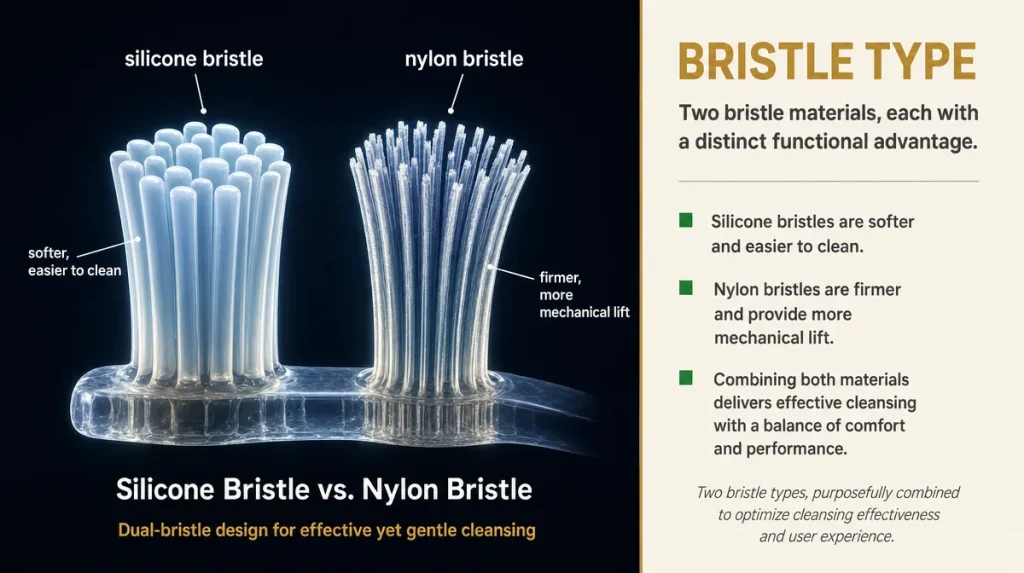
It helps to be specific about your own skin rather than the skin you’d like to have. Oilier, thicker skin, common across the T-zone for a lot of people, generally tolerates a firmer nylon bristle head used three to four times a week. Drier or thinner skin, common on the cheeks especially in winter, does better with a soft silicone head used two to three times a week at most, often only in the evening.
A household analogy that holds up: think of bristle choice the way you’d think of choosing a sponge for a nonstick pan versus a cast-iron one. Use the wrong one on the wrong surface and you either fail to clean it properly or you damage the surface trying. Skin works the same way, except the damage is a compromised barrier rather than a scratched coating, and it takes weeks rather than one wash to show up.
A short self-test worth doing before committing to any brush routine: cleanse one side of your face by hand for a week and the other side with the brush, at whatever frequency you’re considering, then compare how each side behaves under the same moisturizer. If one side reddens, feels tight, or breaks out more, that is real information about how your skin handles mechanical cleansing, and it is more useful than any five-star review.
Cleaning The Brush Itself, The Step People Skip
A brush that touches your face daily but only gets rinsed under water is, within a couple of weeks, reintroducing some of what it was meant to remove. Bristle heads should be washed with a mild soap and warm water at least once a week, then left to air dry fully upright rather than resting in a closed case while still damp.
Handles with any seam or charging port deserve a look too. If water has ever pooled visibly around a seam, that is worth noting, since trapped moisture is where bacteria accumulate fastest. Replacing bristle heads on the schedule the brush suggests, typically every three months, matters less for cleaning power and more for hygiene: frayed, older bristles hold onto residue in ways fresh ones do not.
This is the step most people skip entirely, and it is also the simplest explanation for why a brush that worked well at first starts to correlate with breakouts along the jaw or chin a few months in. The bristles did not stop working. They started harboring what they were supposed to remove.
Key Takeaways
A facial cleansing brush is a mechanical tool, not a treatment, and its value depends entirely on matching bristle stiffness and frequency to your own skin’s tolerance. Softer bristles and lower speeds generally serve more skin types safely. Results, when they come, show up over four to six weeks as smoother texture and less visible congestion, not overnight change. Redness, stinging, or tightness after use is real feedback, not a sign of deeper cleaning. And the brush itself needs regular washing and periodic bristle replacement, since a dirty brush undoes much of what it is meant to accomplish.
A Practical Checklist Before You Buy Or Keep Using One
- Press the bristle head against your wrist: soft like a toothbrush is right for daily facial use, stiff like a nail brush is not.
- Time your cleanse to about one minute, using a song chorus as an informal timer rather than guessing.
- Start at two to three uses a week and adjust from there based on how your skin looks the next morning, not that same night.
- Wash the bristle head weekly with mild soap and let it air dry fully before storing it.
- Replace the bristle head roughly every three months regardless of how clean it looks.
- Try the one-side test for a week if you are unsure whether your skin tolerates mechanical cleansing at all.
- Stop immediately if you notice persistent redness, stinging, or a tight feeling that lasts past your morning routine.
This article is for general information only and is not a substitute for personalized advice from a dermatologist.
Individual skin responses vary, and results described here may not apply to everyone.