
Dr. Thomas Whitfield, Senior Health and Science Editor.
You find it every August, at the edge of a pool party or a humid subway platform: a smudge of black under one eye, a faint gray shadow under the other. You bought the tube that said waterproof. You believed it. By the time you checked a bathroom mirror, half of it had migrated.
The truth is that not all waterproof mascaras are built the same way, and the word itself is barely regulated. One brand’s waterproof formula survives an ocean swim. Another one runs the second you tear up during a sad movie. The difference comes down to a handful of ingredients and a testing standard that most shoppers never see on the label.
This guide walks through what actually makes a mascara water-resistant, what claims are mostly marketing, and how you can judge a formula yourself at the drugstore counter before you spend a single dollar.
- Waterproof formulas rely on silicone or wax polymers, not stronger pigment, so the ink itself is not what resists water.
- A flake-resistant formula and a smudge-resistant formula are not the same thing, and most complaints trace back to confusing the two.
- The best self-test takes thirty seconds with a wet fingertip at the counter, no purchase required.
What “Waterproof” Actually Means On A Label
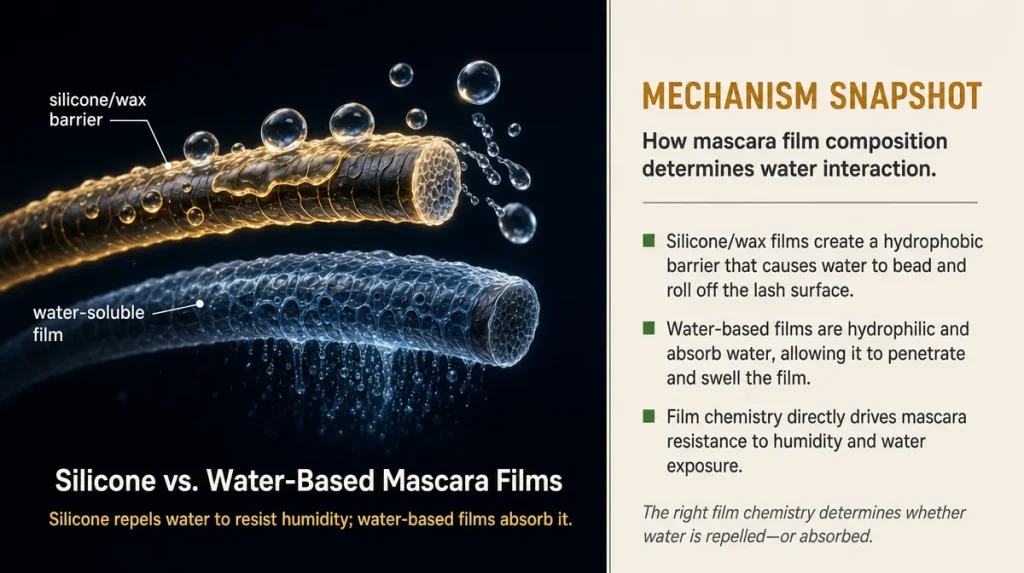
The word waterproof has no fixed legal definition in US cosmetics regulation the way SPF numbers do for sunscreen. A brand can print it on a tube after passing an internal test that may be as simple as a dunk in a bowl of water for sixty seconds.
What is consistent, at least among formulas that genuinely hold up, is the base chemistry. Waterproof mascaras swap water as the main carrier for silicones or waxes, the same family of ingredients that make a raincoat shed rain instead of soaking it in. Water-based mascaras, by contrast, soften the moment humidity or tears touch them, the way a chalk drawing blurs in the rain.
A quick way to judge a formula before buying: check the first few ingredients on the box. If you see cyclopentasiloxane, dimethicone, or a wax like candelilla or beeswax near the top of the list, you are looking at a formula built to resist moisture at the chemical level, not just a marketing label stuck on a regular formula.
Finding Your Undertone, And Why It Matters For Mascara Shade
Most people assume mascara only comes in black, but shade still matters, especially for fair and light skin tones where jet black can look harsh under daylight. A dark brown or brown-black often reads more natural against lighter lash lines, while deeper skin tones tend to carry true black well without looking flat.
The simplest test is daylight, not the bathroom mirror. Store lighting and phone cameras both distort color. Step near a window, or outside if you can, and look at your lashes without makeup. If they already look dark, a brown-black waterproof formula will likely blend more naturally than jet black.
This is a minor point compared with formula chemistry, but it explains why a highly rated waterproof mascara can still look wrong on your particular lashes. The resistance to water is about the base formula. The look is about pigment choice, and that part really is personal.
The Mistake Everyone Makes: Layering For Volume
A common habit is swiping mascara back and forth repeatedly, aiming for thicker lashes. With waterproof formulas, this often backfires. The fast-drying polymers that make the formula water-resistant also make it prone to clumping once too many layers are built up in quick succession.
A cleaner method is one even coat, applied from root to tip in a single motion, followed by a thirty-second pause before a second light pass if more volume is wanted. Waterproof formulas dry faster than regular mascara, often within fifteen to twenty seconds of application, so a second coat applied too early can drag the first layer and create uneven clumps rather than smooth volume.
Another frequent error is skipping the wand’s natural shape. Curved wands are built to catch outer lash corners; straight wands handle the center. Fighting the wand’s design, rather than matching the stroke to the lash shape, is a common reason people describe a formula as flaky or spidery when the real issue is the method, not the mascara.
Why Cheaper Formulas Smudge Even When The Box Says Waterproof
Price is not always a reliable signal, but there is a real, verifiable reason inexpensive waterproof mascaras sometimes underperform. Silicone-based film formers cost more to source in higher concentrations than the waxes often used as filler in budget formulas. A formula that leans more heavily on wax and less on silicone polymer may survive a splash of water but will often transfer under direct sweat or tears, because wax softens at body temperature in a way that silicone resists.
This is not a universal rule. Some drugstore waterproof formulas test well specifically because they prioritize the silicone ratio over fragrance, color additives, or other filler ingredients. The honest shortcut is reading the ingredient list rather than trusting shelf placement or price point alone.
A 2019 study in the International Journal of Cosmetic Science comparing film-forming polymers in cosmetic formulations found that silicone-based films showed measurably higher resistance to both water and sebum compared with wax-based films under controlled humidity and temperature conditions. That gap is the practical difference between a mascara that survives a humid commute and one that does not.
What Realistic Wear Time Looks Like, And How To Judge It Fairly

A fair expectation for a genuinely water-resistant formula is eight to ten hours of wear without smudging under normal conditions, meaning light humidity, no direct water contact, and typical blinking and tear production. That is different from claims of all-day wear in every condition, which no formula reliably delivers.
Judge a formula over at least three wears before deciding it has failed you. A single bad day could be humidity, an eyelash curler used too close to the base, or an eye cream that migrated onto the lash line and broken down the formula’s film. Oil-based eye creams in particular are a common, overlooked cause of mascara breakdown, since oil dissolves both silicone and wax films given enough time.
The Mayo Clinic’s general guidance on eye-area skin care notes that the skin around the eyes is thinner and more prone to irritation than skin elsewhere on the face, which is part of why eye-area products, including mascara removers, are formulated more gently. That gentleness is also why waterproof formulas need a dedicated oil-based remover rather than ordinary face wash, since gentle cleansers are not built to break the same film formers that make the mascara water-resistant in the first place.
The Thirty-second Counter Test Before You Buy
Before buying, most drugstores and beauty counters allow a tester swatch on the back of the hand. Apply a small amount, let it dry for the full fifteen to twenty seconds a waterproof formula needs to set, then run the swatch under a faucet or dab it with a wet fingertip.
A genuinely water-resistant formula will bead water on the surface, similar to a raincoat, and hold its line with light rubbing. A formula leaning more on wax than on silicone will often smear or lighten under the same test, even if the word waterproof appears on the tube.
This test will not tell you how a formula performs against tears, since tears carry salt and body heat that a faucet test does not replicate, but it is a reliable screen against formulas that use the word loosely. It costs nothing and takes less time than reading the ingredient panel in store lighting.
Removing It Without Damaging Your Lashes
The same film-forming ingredients that resist water also resist most regular cleansers, which is why tugging at waterproof mascara with a dry cotton pad is one of the most common causes of lash breakage people never trace back to the right cause.
An oil-based remover, whether a dedicated bi-phase formula or a plain facial oil, breaks down silicone and wax films the way dish soap breaks down grease on a pan. The method matters as much as the product: soak a cotton pad, press it against closed lashes for ten to fifteen seconds without rubbing, then wipe gently downward in one motion.
The American Academy of Dermatology’s general guidance on eye makeup removal recommends avoiding rubbing or pulling at the eye area, since repeated friction can weaken lashes at the root over time and contribute to thinning along the lash line. For waterproof formulas specifically, patience during removal matters more than force, since the formula is designed to resist exactly the kind of quick wipe most people reach for when they are in a hurry.
Key Takeaways
Waterproof resistance comes from silicone or wax polymers in the formula, not from a stronger pigment or a bigger brush. Checking the ingredient list, rather than trusting the word on the box alone, is the most reliable way to predict real-world performance.
Application technique affects outcome as much as formula choice: one even coat, a short pause before a second pass, and a wand stroke that matches your lash shape will outperform aggressive layering nearly every time.
Removal deserves the same care as application. An oil-based remover and a gentle, unhurried technique protect both the lash line and the skin around it, which is thinner and more reactive than skin elsewhere on the face.
A Quick Checklist For Your Next Purchase
- Check the ingredient list for silicone (dimethicone, cyclopentasiloxane) or wax near the top rather than relying on the word waterproof alone
- Test a swatch on your hand, let it dry fully, then run it under water before buying
- Match brown-black or black to your natural lash color in daylight, not store lighting
- Apply one even coat and wait before a second pass to avoid clumping
- Use an oil-based remover and avoid rubbing to protect the lash line
- Judge a formula over three wears, not one, before deciding it works or fails for you
This article is for general information and does not replace individual medical or dermatological advice.
Individual results vary depending on skin type, application method, and environmental conditions.