
Dr. Thomas Whitfield, Senior Health and Science Editor.
You know the drawer. Six or seven tubes of liquid lipstick, most used twice, half of them dried out at the cap because the formula turned tacky before lunch was even over. You bought each one hoping it would be the one that survives coffee, a mask, a long day, without turning into a cracked line by 3 p.m. Somewhere in there you typed “best long wear liquid lipstick” into a search bar at midnight and got a wall of listicles that all recommend different things.
Here is the useful fact before anything else: most long-wear liquid lipsticks do not stay put because of pigment. They stay put because of a thin plastic-like film that forms on your lips as the solvent evaporates, and that film behaves more like a coating you paint on than a lipstick you swipe on. Once you understand that mechanism, you can judge any formula yourself, in the store, before you spend a cent. That is what this guide is for. No rankings, no favorites, just the physics and the habits that actually decide whether a lipstick makes it through your day.
- Long wear comes from film-forming polymers, not pigment concentration, so a lipstick’s staying power has almost nothing to do with how saturated the color looks in the tube.
- Application technique changes wear time more than the product does: a too-thick first coat is the single most common reason liquid lipstick cracks or transfers by midafternoon.
- Climate and diet undo formula chemistry, so the same lipstick can perform completely differently on a humid August day near the coast than during a dry, heated January indoors.
Finding Your Undertone In Daylight
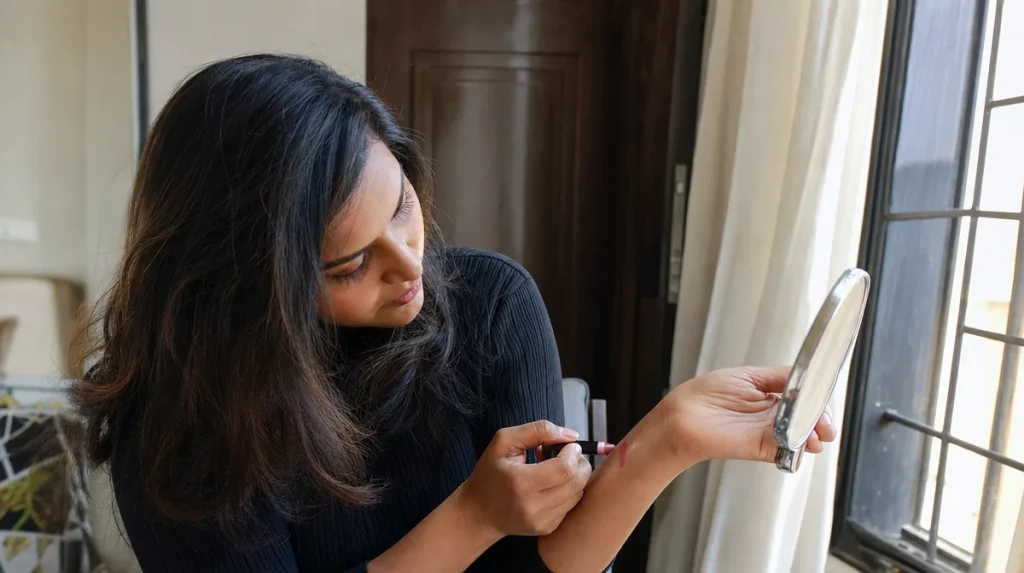
Store lighting lies. Fluorescent overheads and warm boutique bulbs both shift how a shade reads on your skin, which is why a color that looked perfect under a drugstore’s harsh light can look chalky or orange the moment you step outside.
The fix is simple and takes thirty seconds. Swatch a small amount on the inner wrist, not the back of the hand, and walk to the nearest window or exit. Daylight, even through glass, is the only reliable judge. If you are shopping online, look for swatches shown on multiple skin tones across the fair, light, medium, tan, and deep range rather than a single model’s arm.
Undertone matters more than most shoppers assume. A blue-red on someone with cool, pink undertones will look rich and clean, while the same shade on warm or olive undertones can look muddy within an hour, as the pigment oxidizes slightly against the skin’s natural oils. This is not a flaw in the lipstick. It is basic color theory, the same reason a paint chip looks different in a north-facing room than a south-facing one.
A quick self-test: hold a piece of white paper under your chin. If your skin looks more yellow or golden against it, you likely lean warm. If it looks pink or bluish, you likely lean cool. Neither answer tells you what shade to buy, but it tells you which family of reds, berries, or nudes to start swatching first, which saves you from buying four almost-right tubes before finding the right one.
What “Long-wear” Actually Means Chemically
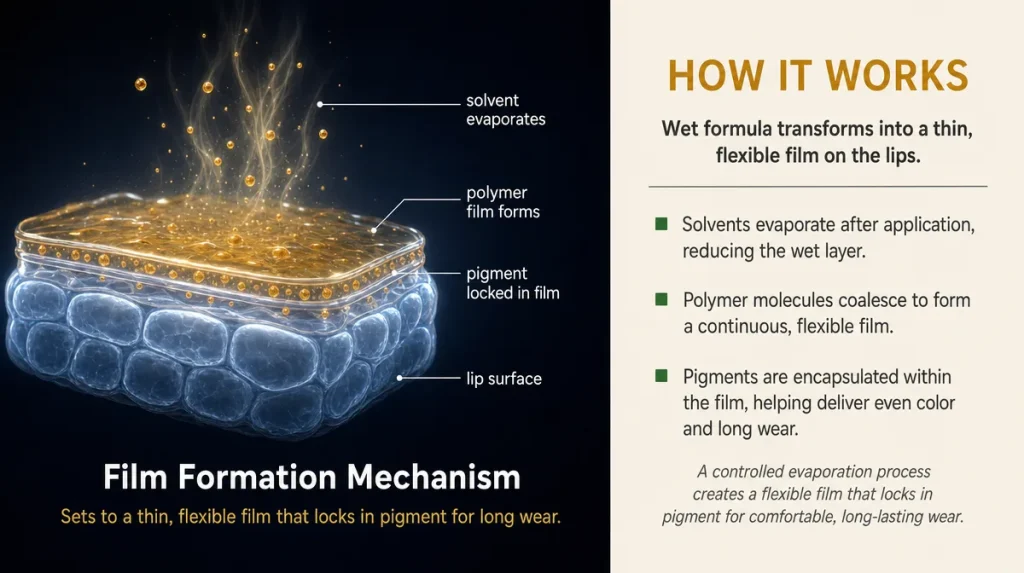
The words “long-wear” and “transfer-resistant” on a label describe a specific chemical strategy, not a marketing feeling. Most of these formulas rely on film-forming polymers, ingredients such as trimethylsiloxysilicate or various acrylate copolymers, suspended in a fast-evaporating solvent like isododecane or a volatile silicone.
When you apply the product, the solvent evaporates within a minute or two, leaving behind a thin, flexible film that grips the surface of the lips rather than sitting in the oils the way a traditional cream lipstick does. A useful household comparison is nail polish: the color goes on wet and workable, then hardens into a coating you cannot easily smear, because the liquid carrier has left and only the film remains.
A 2021 study in the International Journal of Cosmetic Science measured wear time across several liquid lipstick formulations and found that polymer film thickness correlated far more strongly with transfer resistance than pigment load did. In other words, two lipsticks with identical color intensity can have wildly different staying power depending on the film-forming system underneath.
This explains a common complaint: a liquid lipstick that looks pigmented and rich in the tube but fades fast on the lips likely has a weak or thin film former, or too much emollient oil mixed in to keep lips comfortable, which softens the film and shortens wear. Comfort and longevity sit at opposite ends of the same formulation decision, and no brand has fully solved that trade-off.
The Application Method That Decides Whether It Lasts
Even a well-formulated long-wear lipstick fails if it goes on the way you would apply a regular one. The most common mistake is one thick, even coat straight from the wand, the way you might apply a moisturizing lipstick.
Because these formulas set by evaporation rather than by absorbing into the skin, a thick layer takes longer to dry and dries unevenly, which is exactly when cracking starts. The lips move, most in the center where they open widest, and a thick film there splits first.
A better method: apply a thin first layer, let it set for sixty seconds without pressing the lips together, then apply a second thin layer only where color looks patchy. This builds the film in stages that dry evenly rather than one slab that dries from the outside in while staying wet underneath.
Blotting matters too, though it feels counterintuitive with a product marketed as long-wear. A single light blot with a folded tissue after the first coat removes excess product that would otherwise sit as a weak point in the film.
Exfoliation the night before, not the morning of, also changes outcomes. Applying film-forming lipstick over dry, flaking skin traps those flakes under the coating, and the whole film can peel away in one piece by early afternoon, taking the color with it. The American Academy of Dermatology’s general guidance on lip care notes that gentle exfoliation and a nightly balm reduce flaking, which is exactly the surface a long-wear formula needs to bond well.
Mistakes That Cause Fading, Transfer, And Flaking
Most complaints about liquid lipstick trace back to a small set of habits rather than a bad formula.
Eating oily or greasy foods breaks down the polymer film faster than plain water does, because many film formers are more soluble in oil than in water. A burger at lunch will do more damage to a long-wear lipstick than an entire glass of iced tea.
Lip balm applied on top, even hours later, softens the film from above. If you need moisture during the day, dabbing a balm only at the very center of the lips, away from the outer edge where the film is thinnest, causes less breakdown than a full swipe.
Rubbing the lips together to “blend” a patchy application is another common habit that backfires. It thins the film unevenly and creates the exact patchiness the rubbing was meant to fix.
Finally, storage matters more than people expect. Leaving a tube in a hot car or a sunlit bag can separate the solvent from the pigment and polymer, changing the formula’s texture permanently. A lipstick that goes gluey or stringy after a summer in a tote bag has usually been heat-damaged, not made poorly.
Reading The Ingredient List Without A Chemistry Degree
You do not need a lab background to read a lipstick’s ingredient panel usefully. Three categories are worth scanning for.
First, film formers: names ending in -siloxane, -silicate, or -copolymer near the top of the list suggest a formula built for wear time. If none of these appear until far down the list, the product is likely leaning on wax and oil for staying power, which behaves more like a traditional cream lipstick regardless of how it is marketed.
Second, volatile solvents such as isododecane or cyclopentasiloxane near the top of the list explain why a formula feels wet on application and dries within a minute. Their presence is normal and expected in this category, not a red flag.
Third, emollients like dimethicone, various oils, or glycerin further down the list soften the film and improve comfort, but too many, too high on the list, usually mean the trade-off has shifted toward comfort at the expense of wear time.
Biochemists who study dermal delivery point out that ingredient order reflects concentration by law, so a formula that lists three emollients before any film former is telling you plainly, in its own legal language, which property it prioritized. This is one of the few places where the label does not need translating: it is already an honest ranking of what is inside.
What Matters Versus What Is Marketing
Certain words on liquid lipstick packaging describe real chemistry. Others describe feeling, not function.
“Transfer-resistant” and “waterproof” claims typically refer to standardized rub and immersion testing, which is measurable and repeatable. Retailers such as Sephora and Ulta Beauty list these claims consistently across brands, which at least allows some apples-to-apples comparison at the shelf.
“Weightless” or “second-skin feel,” by contrast, describe sensory perception with no fixed industry definition. They are not false exactly, but they are subjective, and two people can disagree completely about whether the same formula feels weightless.
“Clinically proven” is a phrase that means nothing on its own. It only carries weight if the brand names the study, the sample size, and what specifically was measured. Good Housekeeping’s Institute, which has lab-tested consumer products since the early twentieth century, has noted in its general beauty testing guidance that vague clinical language without published methodology should be treated as a claim, not a fact.
Finish names like “matte,” “satin,” or “velvet” describe the finished film’s light reflection, which is real and visible, but they say nothing about how long that film will last. A matte finish can wear beautifully or terribly. The word matte is describing optics, not durability.
Running Your Own Wear Test Before You Commit
The only test that matters is the one you run on your own lips, in your own week, because lip chemistry, saliva pH, and habits vary enough between people that lab data only gets you so far.
Pick an ordinary day, not a big event, and apply the lipstick the way you normally would, including your usual coffee, lunch, and water intake. Check it at three points: right after lunch, mid-afternoon, and at the end of the day. Note not just whether color remains, but how it fades: evenly across the whole lip, which is normal and expected, or unevenly with a hard ring around the edge, which usually means the film cracked and lifted in one place.
Run the same test again on a very different kind of day, ideally once during a humid stretch and once during dry, heated weather. East Coast summer humidity keeps lips naturally more hydrated, which can help some films bond and hurt others by preventing them from setting fully. Dry winter air with indoor heating dehydrates lips fast, which often reveals a formula’s tendency to flake that summer humidity had been masking.
A lipstick that performs consistently across both conditions is doing something right at the formulation level. One that only performs well in one season is not necessarily bad, just seasonal, the same way some moisturizers are better suited to winter than August.
Key Takeaways
Long wear comes from a polymer film, not from how bold the color looks in the tube. Thin, layered application beats one thick coat every time. Oily food, added balm, and rubbing your lips together are the three habits most likely to break a film down early. Ingredient order on the label tells you, plainly, whether a formula prioritized wear time or comfort. And the only test that really settles the question is the one you run yourself, across an ordinary day and across different seasons.
A Quick Checklist For The Shelf Or The Search Bar
- Swatch in daylight, not store lighting, before judging color
- Scan the ingredient list for film-forming polymers near the top
- Expect a trade-off between comfort and wear time, and decide which matters more for your day
- Apply in two thin layers rather than one thick one, blotting lightly after the first
- Exfoliate the night before, not the morning of application
- Test performance across at least one humid day and one dry, heated day
- Treat “clinically proven” as a question, not a fact, unless a study is named
This article is for general information and does not replace advice from a dermatologist or other qualified professional.
Individual results vary based on skin type, climate, and habits, so your own wear test is the most reliable guide.