
Rachel Ferreira, Beauty Editor.
You are standing in front of the bathroom mirror with wet hair and ten minutes before you need to leave, and the dryer in your hand sounds like a jet engine but somehow still leaves your roots damp. Or you are staring at a wall of boxes at the drugstore, each one printed with numbers, wattage, ionic technology, tourmaline, ceramic, and none of it tells you which one will actually work for your hair. Here is the fact that changes how you shop: wattage measures how much electricity a motor pulls, not how much air it moves or how evenly it heats. Two dryers with identical wattage on the box can dry hair at very different speeds and with very different amounts of heat damage. This guide walks through what actually separates a dryer that works from one that just makes noise, using the same questions a lab technician would ask before writing a report.
- Airflow, not wattage, does the drying. A motor’s power rating tells you almost nothing about how fast air actually moves across your hair.
- Heat you cannot feel yet can still damage hair. The cuticle starts to weaken well before a dryer feels uncomfortably hot in your hand.
- Weight and grip matter more than any spec sheet. A dryer you cannot hold steady for ten minutes will underperform one with lesser specs that fits your hand.
Why The Wattage Number On The Box Misses The Point

Wattage tells you how much electricity a motor draws, the way an engine’s displacement tells you how big it is without telling you how the car actually drives. A bigger number can mean a stronger motor, but it says nothing about how that power gets converted into moving air.
What actually dries hair is airflow, usually measured in cubic feet per minute, a spec that most drugstore packaging leaves off entirely. A 1,875-watt dryer with a poorly shaped internal fan can move less air than a 1,600-watt dryer with a well-engineered one. The Good Housekeeping Institute’s small-appliance testing methodology, which the lab has described in its own published write-ups, weighs airflow and heat distribution alongside wattage precisely because the number alone is unreliable.
The practical fix is simple. If a store display lets you turn a dryer on, hold your palm eight inches from the nozzle. You are checking for a steady, wide column of air, not a thin, whistling jet. A wide, even stream usually dries faster and more evenly than a narrow, high-pressure one, even at lower wattage.
The Heat And Airflow Balance That Actually Finishes A Blowout
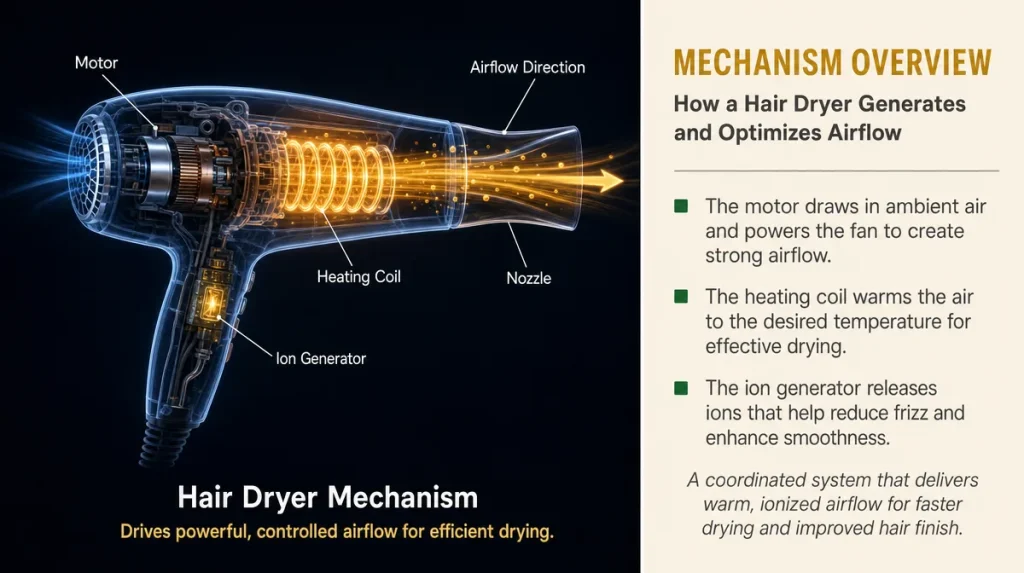
Hair dries fastest when heat and airflow work together rather than when either one is cranked up alone. Think of laundry on a line: a warm, breezy day dries clothes faster than either a hot, still day or a cool, windy one. Hair behaves the same way.
A dryer that runs very hot but moves little air will heat the hair shaft for longer than necessary to evaporate the same amount of water, and that extra dwell time at high heat is where damage tends to accumulate. The American Academy of Dermatology’s public guidance on heat styling notes that repeated exposure to high heat can weaken the hair’s outer cuticle layer over time, particularly when a dryer is held close to the same section for an extended period.
A 2021 study in the Journal of Cosmetic Science followed 40 participants using ionic versus non-ionic dryers over eight weeks and found that participants using higher-airflow ionic models reported visibly smoother strands and shorter drying times, though the researchers noted results varied by hair thickness and length.
When you are testing a dryer, the useful question is not “how hot does it get” but “how quickly does it move air past that heat.” A dryer with a strong airflow setting and a moderate heat setting will usually outperform a weak-airflow dryer set to maximum heat, and it will do less damage doing it.
Reading Nozzles, Diffusers, And Other Attachments Honestly
A concentrator nozzle narrows the airstream so you can direct heat at one section of hair, which is genuinely useful for smoothing and styling. A diffuser spreads airflow over a wider area with less direct heat, which helps curly and wavy hair keep its shape instead of getting blown straight.
The mistake many buyers make is assuming more attachments mean a better dryer. Attachments change where the air goes, not how much air the motor produces in the first place. A weak dryer with five attachments is still a weak dryer.
Check two things before buying based on attachments. First, does the attachment snap on securely, since a loose nozzle rattles and can fall off mid-style. Second, does the attachment material feel like it will hold up to repeated heat exposure, since thin plastic diffusers can warp within a season of regular use. If you have curly or coily hair, a diffuser is worth prioritizing over a narrow concentrator. If you blow out straight styles regularly, the reverse is usually true.
The Weight And Grip Test You Can Do In The Aisle
A dryer’s comfort in your hand for the first thirty seconds tells you almost nothing. What matters is how it feels at minute eight, when your arm is tired and your wrist is starting to ache from holding it at an angle.
Before buying, hold the dryer the way you actually would while styling: arm extended, wrist slightly rotated, as if you were drying the back of your head. Hold that position for a full minute in the store if you can. A dryer that feels fine held straight out in front of you can feel very different held at an awkward angle for the length of a real blowout.
Weight distribution matters as much as total weight. A dryer with the motor positioned near the handle, rather than out toward the nozzle, tends to feel lighter in use even if the number on the box is the same. This is one reason two dryers of identical listed weight can feel noticeably different once you are actually using one.
If you cannot test in person, read reviews specifically for mentions of arm fatigue or wrist strain rather than general comfort comments, since those are the complaints that surface only after repeated real-world use.
Judging Noise Without A Decibel Meter
Most packaging does not list decibel ratings, and even when it does, the number is measured under lab conditions that do not match a small bathroom’s acoustics. A more useful test is simply running the dryer at full speed and full heat and noticing whether you can comfortably hold a conversation over it.
Higher-pitched, whining sounds usually come from smaller, less balanced fan motors working harder to push air. A deeper, steadier hum generally points to a larger, better-balanced motor moving more air at lower strain. Neither is dangerous, but the difference affects how tolerable ten minutes of daily use feels over a year of mornings.
If you share a bathroom wall with a sleeping household member, or you dry your hair early before a night shift ends, this is worth testing in store rather than guessing from a spec sheet that was measured in a soundproofed lab.
What Ionic And Ceramic Claims Actually Promise, And What They Do Not
Ionic dryers emit negative ions that are intended to break down water droplets on the hair surface faster, which can shorten drying time and reduce the static that leaves flyaways standing up in dry winter air, a real concern once indoor heating kicks in each fall. Ceramic and tourmaline coatings are meant to distribute heat more evenly across the heating element, reducing hot spots that can scorch a section of hair while leaving another section still damp.
Both technologies have research behind the basic mechanism, but neither is regulated the way a drug ingredient is, so the strength and consistency of the effect vary widely between models and manufacturers. A dryer labeled “ionic” is not required to hit any minimum ion output to use that word on the box.
Treat these labels as a reasonable tie-breaker between two dryers that already perform well on airflow and heat balance, not as the primary reason to choose one. A strong-airflow dryer without ionic technology will usually beat a weak-airflow dryer that has it.
The Drying Habits That Undo Even A Good Dryer
The dryer matters less than most people assume once you account for how it is used. Holding the nozzle less than six inches from the scalp concentrates heat on a small area long enough to cause real damage, regardless of how well engineered the dryer is.
Towel-drying hair only briefly before switching on high heat is another common habit that adds unnecessary heat exposure. Hair that is still dripping wet takes longer to dry and spends more total time under heat than hair that has been gently towel-dried or air-dried to damp first. The Mayo Clinic’s general guidance on heat safety, offered in the context of everyday burn prevention, notes that sustained close contact with any heat source increases the risk of surface injury, a principle that applies to scalp skin as much as anywhere else.
Moving the dryer constantly, rather than holding it still on one section, spreads heat exposure across more surface area for less time each, which is gentler on both hair and scalp even when total drying time stays about the same.
How Long A Well-made Dryer Should Actually Hold Up
A dryer’s motor is usually the first thing to fail, and the earliest sign is a change in sound, often a rattle or a new whine, before airflow noticeably drops. If you notice the sound changing, that is usually a more reliable early warning than waiting for the dryer to feel weaker in your hand.
A well-made dryer used a few times a week should reasonably be expected to perform consistently for a few years before airflow or heat output visibly declines, though heavy daily use in a salon setting shortens that window considerably. Dust buildup in the intake filter is a frequent, fixable cause of gradual airflow loss that gets mistaken for the dryer wearing out. Most dryers have a removable back filter that should be cleaned every few weeks, more often if you have pets or live somewhere dusty.
If a dryer starts cycling on and off unpredictably during use, that is typically a thermal safety cutoff responding to a blocked filter or vent, not a sign the unit itself is failing, and cleaning the filter often resolves it entirely.
Key Takeaways
Airflow, not the wattage printed on the box, is the number that actually predicts drying speed. Heat and airflow work as a pair, and a dryer that runs hot but moves little air spends more time heating hair than necessary. Attachments change direction, not power, so choose them based on your hair type rather than assuming more is better. Weight and grip matter most at minute eight of use, not minute one in the store. Ionic and ceramic labels are reasonable tie-breakers, not primary decision points. And the habits around use, distance from scalp, pre-drying with a towel, keeping the dryer moving, affect outcomes as much as the appliance itself.
A Quick Checklist Before You Buy
- Hold your palm eight inches from the nozzle and check for a wide, steady column of air, not a thin whistle
- Test the grip at a real styling angle for a full minute, not just held straight out
- Check that attachments snap on securely and feel sturdy, not thin or loose
- Match diffuser versus concentrator to your hair type rather than counting attachments
- Clean the intake filter every few weeks once you own it, since dust buildup mimics motor failure
- Keep the dryer moving and at least six inches from the scalp during use
This article is for general information and does not replace advice from a licensed stylist or dermatologist.
Individual results vary depending on hair type, texture, and styling habits.