
Dr. Thomas Whitfield, Senior Health and Science Editor.
You catch your reflection in the bathroom mirror around eleven in the morning and there it is: two smudges under your eyes where your lashes used to be, and the fullness you painted on two hours ago has collapsed into a spiky little clump at the outer corner. The drawer under your sink holds three or four half-used tubes, each one a holy grail for about a week before it started flaking, smearing or simply refusing to build past a thin coat. Here is the fact that changes most of that: a mascara wand does not paint lashes the way a brush paints a wall in one pass. It builds thin layers, and volumizing formulas are thicker and stickier than everyday ones specifically so they can hold that build. That thickness is exactly what turns into clumps the moment you apply it the wrong way. Once you understand how the layering is supposed to work, the daily mistakes: pumping the wand, piling on a second coat too soon, skipping the lash comb, mostly explain themselves, and so does the fix.
- Wait between coats instead of piling them on: volumizing formulas need roughly fifteen to twenty seconds to set before a second layer goes on, or the wet polymer just drags into clumps.
- The wand shape decides more than the label does: a tightly spaced, curved brush distributes a thick formula evenly, while a straight, sparsely bristled wand of the same formula will clump on the same lashes.
- Removal technique determines whether tomorrow’s coat performs: tugging or rubbing off mascara strips healthy lashes along with the pigment, weakening the base the next coat has to grip onto.
Why Volume Formulas Clump When Everyday Mascara Doesn’t
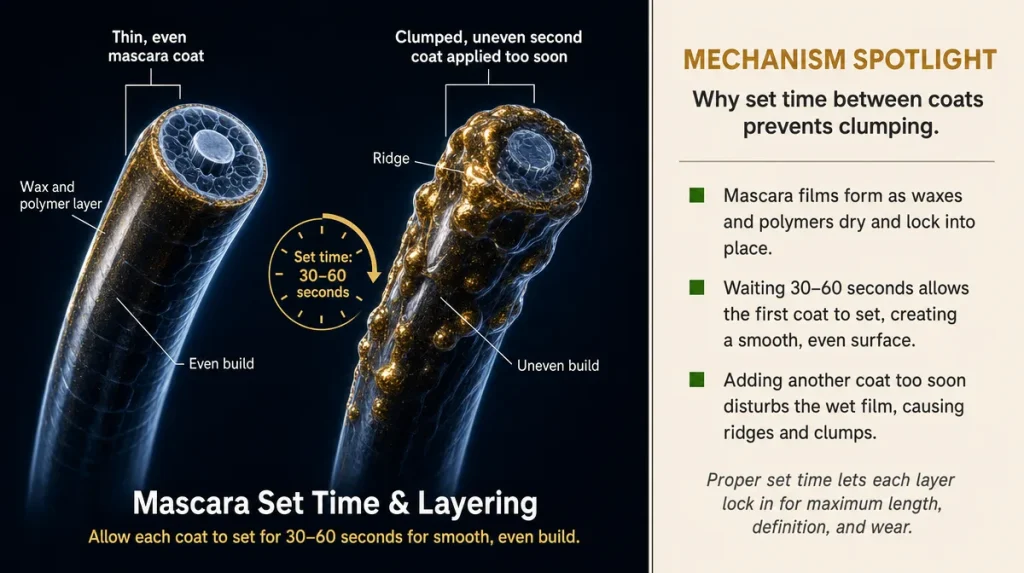
Volumizing mascara carries more wax, more film-forming polymer and often synthetic fibers than a standard lengthening formula. That extra payload is what builds the illusion of thicker lashes, but it also means the product stays workable, meaning wet and moveable, for longer after it leaves the tube.
Think of it the way a house painter thinks about a second coat of paint. A thin coat of wall paint dries in minutes and takes a second pass cleanly. A thick, glossy coat stays tacky far longer, and if you drag a brush through it before it sets, you lift ridges instead of laying down a smooth layer. Mascara behaves the same way on a much smaller scale.
A 2023 study in the Journal of Cosmetic Science, testing repeated-coat application on false lash strips, found that applying a second coat before the first had visibly set increased clump formation and uneven distribution compared with coats applied after a short pause. The difference was measurable under magnification, not just cosmetic guesswork.
This is also why the same tube can look completely different on two people. Lash density, natural oil production and even how warm your bathroom is (humid East Coast summers behave differently than dry winters with the heat running) change how fast that polymer sets, which changes how forgiving the formula feels day to day.
Reading The Wand Before You Read The Label
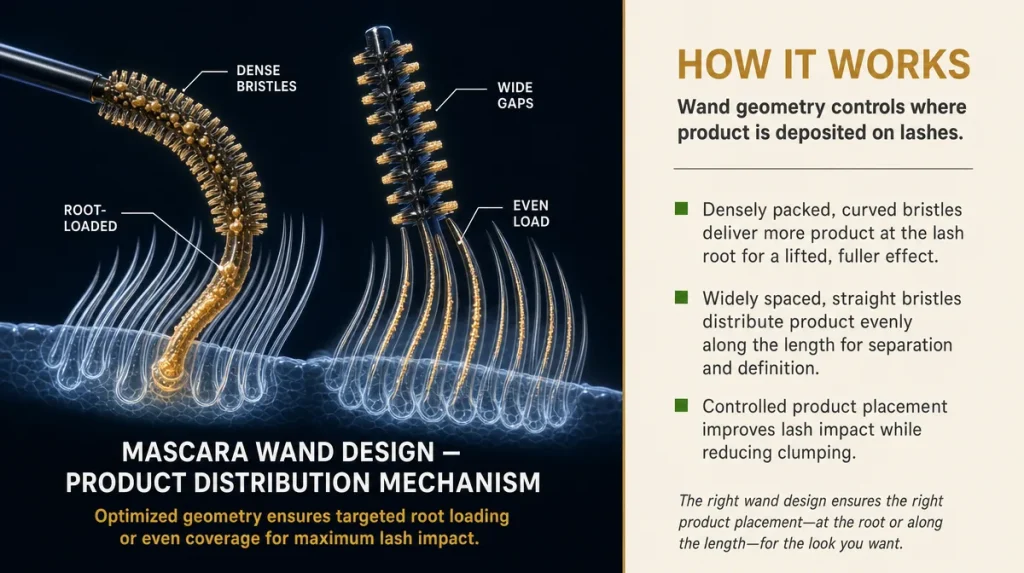
Most shoppers standing at a drugstore or Ulta Beauty display judge a volumizing mascara by the word on the tube. The wand tells you more.
A densely packed, slightly curved brush with short, close-set bristles distributes a thick formula in thin, even passes, which is what volume actually needs. A wand with long, widely spaced bristles or a straight barrel tends to deposit the same formula in heavier globs, because there is more room between bristles for product to gather.
A quick self-test in the store: turn the wand sideways and look at the bristle spacing against the light. If you can see clear gaps wider than the bristles themselves, that wand is built for length or separation, not volume, no matter what the front of the box says.
Ball-tipped or hourglass-shaped wands, common on many current formulas, are usually designed to load more product at the base of the lash and less at the tip, which mimics natural thickness rather than exaggerated length. Straight cylindrical wands do the opposite and tend to load evenly, which can look thin at the root even when the formula itself is dense.
This matters more than most fiber or peptide claims printed on the packaging. A well-shaped wand carrying an ordinary formula will usually outperform a loaded, buzzword-heavy formula paired with the wrong brush.
The Two-coat Method, Done In The Right Order
Most people apply mascara from root to tip in one motion, then repeat immediately. That second pass is where volume mascara usually goes wrong.
The method that actually builds volume without clumping starts at the root. Wiggle the wand gently side to side against the base of the lashes for a second or two, which deposits pigment where the eye reads density most, then draw upward in one smooth stroke to the tip. Let that coat sit for roughly fifteen to twenty seconds, enough time for the surface to lose its wet shine, before going back in.
On the second pass, work only the roots and mid-lengths again rather than repeating the full stroke. The tips already have product on them, and adding more there is what typically produces the small hard clumps people notice at the outer corner by midday.
A lash comb or the clean side of a spoolie, run through while the second coat is still slightly tacky, breaks up any beading before it sets. Skipping this step is one of the most common reasons a formula that tested fine in the store looks clumpy by the time you leave the house.
Where Clumping Actually Starts, And It Isn’t The Formula
Ask most people why their mascara clumps and they blame the product. Often the real cause is the pump.
Every time the wand goes back into the tube and gets pushed up and down before coming back out, it forces air into the container and pulls extra product up around the wand’s base. That extra product is what lands on the lashes as a clump on the next stroke, not because the formula is bad, but because too much of it arrived at once.
The better habit is to twist the wand gently as you withdraw it rather than pumping, which coats the bristles evenly without forcing air and excess formula toward the opening. It sounds like a small adjustment, but it is one of the single biggest differences between a clean second coat and a clumpy one, and it costs nothing to change.
Drying tube consistency is the other quiet cause. Mascara that has been open for several months, particularly one that has sat through a hot car in a humid summer or through a dry, heated winter with the cap left loose, thickens as its liquid carriers evaporate. That thickened formula clumps almost regardless of technique. If a long-owned tube suddenly starts performing worse, the tube is usually the problem, not your application.
Matching The Formula To Your Lashes And Your Climate
A formula that performs beautifully in a dry, air-conditioned office can behave completely differently on a humid August afternoon on the East Coast, or during a dry January with the heat running constantly indoors.
Humidity softens wax-based formulas, which is why volumizing mascara that felt sturdy in spring can smudge or slide down by early evening once summer humidity sets in. In that season, formulas leaning more heavily on film-forming polymers tend to hold their shape longer than heavily wax-based ones.
Dry winter air does the opposite: it can make a formula feel flaky or brittle by the end of the day, especially indoors where forced-air heating strips moisture from everything, including the top layer of a mascara coat. Lashes themselves also become drier in that stretch, which means a formula that felt fine in October can feel stiff and prone to flaking by December.
Lash type matters just as much as season. Fine, sparse lashes generally do better with a lighter build and a fiber-based formula, since heavier wax formulas can weigh them down until they curl downward instead of up. Coarser, already-full lashes usually tolerate heavier wax formulas without the same drooping effect. Neither is better; they simply respond differently to the same tube.
The Removal Mistake That Undoes Tomorrow’s Volume
Volume you build in the morning is only half the job. How you take it off at night decides how well the next coat will perform.
Rubbing or tugging at mascara, especially waterproof or heavily fibered formulas, pulls on the lash follicle along with the pigment. The American Academy of Dermatology’s general guidance on eye makeup removal advises against scrubbing at the lash line and recommends a gentle press-and-hold approach with a dedicated remover instead, precisely because repeated pulling can weaken lashes and, over time, thin them out.
The better method: soak a cotton pad with a bi-phase or oil-based remover, press it against closed lashes for roughly ten seconds to let the product loosen the formula, then wipe downward in one motion rather than scrubbing side to side. A cotton swab dipped in remover can clean up any residue left along the root without additional rubbing.
Lashes that are constantly stripped by rough removal come back finer and more brittle, which means the next morning’s volumizing formula has less natural thickness to build on. In that sense, gentle removal is not a skincare afterthought. It is part of what makes tomorrow’s application look fuller, since you are starting from healthier lashes rather than lashes weakened by last night’s shortcut.
Storage, Shelf Life, And The Three-month Rule
Mascara has one of the shortest reasonable shelf lives of any product in a makeup drawer, generally cited by beauty editors and dermatologists at around three months from first opening, and volumizing formulas are no exception simply because they cost more or came in nicer packaging.
Every time the wand goes in and out, it introduces a small amount of air and bacteria into the tube. Over weeks, that changes both the formula’s texture, which is why an old tube starts to drag or clump even with perfect technique, and its safety, since a warm, dark tube is a comfortable place for bacteria to multiply near the eye.
A simple test: if a tube smells noticeably different from when you bought it, feels gritty rather than smooth on the wand, or has visibly dried and stringy formula near the opening, it belongs in the trash regardless of how much product is left inside.
Storage habits extend that window slightly. Keeping the tube upright, capped tightly, and out of direct heat, meaning not left in a hot car or on a sunlit windowsill, slows the evaporation that thickens formula prematurely. It will not turn a four-month-old tube into a fresh one, but it prevents the kind of early clumping that has nothing to do with application technique at all.
What The Marketing Says Versus What Actually Changes Your Results
Packaging on volumizing mascara tends to lean on a short list of words: fibers, peptides, keratin, lash serum complex. Some of these matter. Many are dressing on a formula that would perform the same without them.
Synthetic fibers, when present in meaningful amounts, do add visible bulk by clinging to the natural lash and building outward, which is a real mechanical effect you can sometimes see under magnification. Conditioning ingredients marketed as strengthening lashes over time, by contrast, are present in amounts too small in most drugstore and prestige formulas alike to meaningfully change lash health within the weeks a single tube lasts. Any strengthening effect, where it exists at all, tends to require consistent use over months, not one tube.
The wand shape, the wax-to-polymer ratio and how long the formula stays workable before setting affect daily results far more than any single named ingredient on the box. A useful habit at the shelf, whether at Target, CVS, Walgreens or scrolling Amazon.com reviews, is to read what buyers say about clumping and flaking after several hours of wear rather than reading the ingredient list first. Real-world wear time tells you more than a fiber count ever will.
Key Takeaways
Volume comes from thin, patient layers, not from one heavy pass or a quick second coat. The wand shape matters as much as the formula inside the tube. Climate and lash type change how any formula behaves, so what worked last spring may not work through a humid summer or a dry winter. Gentle removal protects the lashes a future coat has to build on, and even a favorite tube has a real shelf life of about three months.
A Quick Pre-mirror Checklist
- Twist the wand out of the tube instead of pumping it.
- Apply the first coat root to tip, then pause fifteen to twenty seconds before a second pass.
- Comb through with a spoolie while the second coat is still slightly tacky.
- Match wand shape to your lash density: dense curved brushes for volume, wider spaced brushes for length or separation.
- Remove with a press-and-hold method, never a scrubbing motion.
- Replace the tube at roughly three months, sooner if the formula smells different or drags on the wand.
This article is for general information only and does not replace advice from a dermatologist or ophthalmologist.
Individual results vary depending on natural lash density, application technique and climate.